Why Curved Furniture Edges Are Quietly Replacing Sharp Corners
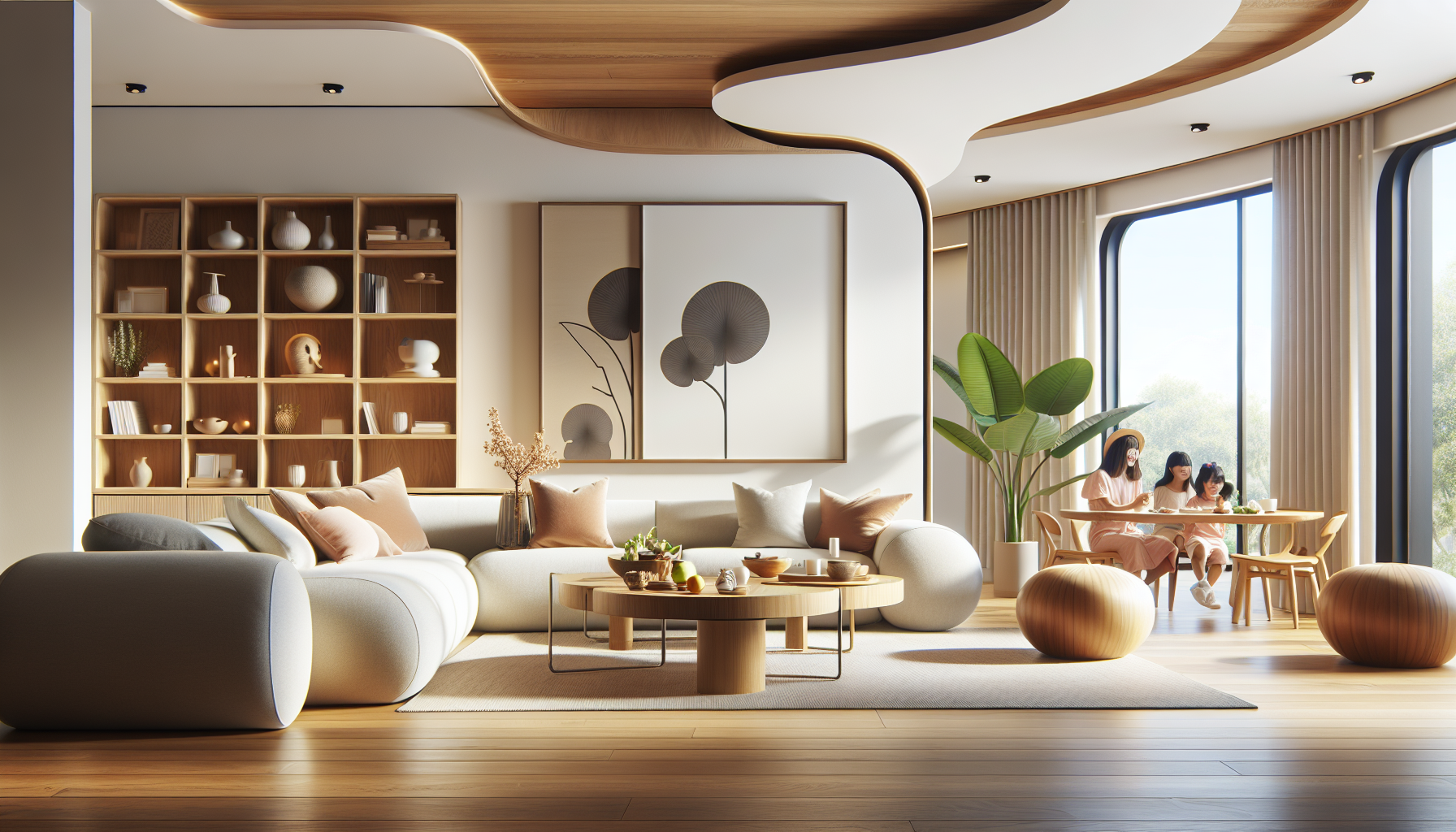
Something has shifted in the grammar of contemporary interiors. The hard right angle — long the default of modernist furniture design, the spec sheet staple of mass-market sofas and dining tables — is quietly ceding ground to the curve. Walk through any design fair from Milan to Copenhagen and the sinuous outline dominates: rounded edges, arched backs, petal-shaped seats, organic silhouettes that seem to breathe rather than simply occupy space. This is not a passing trend. It is, say the designers behind it, a recalibration of what furniture is actually for.
The Lineage of the Curve
The conversation begins, inevitably, with Pierre Paulin. The French designer's Mushroom Chair (1960) and Ribbon Chair (1966), both produced by Artifort, are now canonical examples of furniture conceived as a continuous flowing surface rather than an assembly of planes. Paulin rejected the idea that a chair needed visible structural logic — legs, joints, right angles — and instead shaped foam over steel frames to create sculptures you could sit in. His work sits in the permanent collections of MoMA and the Centre Pompidou and commands prices at auction that reflect its enduring influence.
That influence is visible in the current portfolios of designers who have made soft geometries their signature. India Mahdavi, the Iranian-French architect and designer whose interiors for Sketch in London helped define the maximalist revival of the 2010s, has long worked with rounded forms — her Bishop stool and Monsieur chair both feature curves that invite touch as much as sight. Mahdavi's studio has described the curve as intrinsically hospitable, a shape that signals welcome rather than boundary.
Faye Toogood, whose Roly-Poly chair (2016) became one of the decade's most imitated pieces, takes a different approach: her curves are primitive and sculptural, referencing pebbles and prehistoric forms rather than mid-century modernism. The Roly-Poly's squat, rounded profile — no visible legs, no sharp transitions — has appeared in editorial shoots from Vogue Living to Wallpaper* and was acquired by major collections including the Design Museum in London.
What the Data Shows
The shift is measurable. A 1stDibs trend report published in 2023 noted that searches for "curved sofa" on its platform had increased 68 percent year-over-year, while "curved dining chair" searches were up 44 percent. The platform attributed the surge in part to pandemic-era domesticity — a prolonged period of inhabiting one's home intensely that prompted buyers to reconsider furniture as an emotional, tactile proposition rather than a purely functional one.
Architectural Digest's 2024 design forecast named the curved silhouette among its top five furniture trends, noting that the move reflected a broader cultural appetite for softness and comfort following years of social disruption. Interior designers surveyed by AD cited client briefs increasingly using language like "cocooning," "enveloping," and "restorative" — descriptors that map naturally onto rounded forms.
The Psychology of Softness
There is a body of environmental psychology research that supports what designers have been intuiting. A 2013 study by Moshe Bar and Maital Neta, published in Psychological Science, found that people consistently rate curved objects as more pleasant and less threatening than angular equivalents — a preference theorised to be rooted in evolutionary threat-detection, since sharp angles in nature often signal danger. Interior designers have long applied this heuristic implicitly; the rounded arch, the oval dining table, the tub chair all carry a subconscious permission to relax.
Neurologically, the processing of curved versus angular forms activates different brain regions: curved forms engage areas associated with reward more strongly, according to research from University College London published in PNAS in 2021. For an industry increasingly interested in evidence-based design, this is meaningful data.
Contemporary Production and Accessibility
Curved furniture was historically difficult to mass-produce — foam moulding and bent plywood techniques required skilled labour and expensive tooling. CNC foam cutting and advances in bent-wood lamination have reduced those barriers significantly. IKEA's Gronadal series and H&M Home's regular introductions of curved accent chairs have brought the aesthetic into mid-market retail at accessible price points.
At the higher end, studios including Norr11 (Copenhagen), Hem, and Bolia have made curved upholstery central to their propositions. The Hem Lune sofa, designed by Lars Beller Fjetland, and Norr11's Hippo sofa demonstrate that the curve can operate across formal registers — from the quietly residential to the deliberately sculptural.
The Safety Dimension
Curved and radiused edges have a practical argument beyond aesthetics: they are physically safer. In homes with young children or elderly residents, sharp furniture corners are a documented hazard. The UK's Royal Society for the Prevention of Accidents notes that furniture-related injuries account for a significant proportion of under-five A&E admissions. Rounded corner furniture — a category that barely needed naming when it was simply called "normal furniture" for much of the twentieth century — is now being marketed explicitly as child-safe, closing the loop between aesthetic preference and practical concern.
Where the Trend Is Heading
Designers including Sabine Marcelis and Objects of Common Interest are pushing beyond upholstery into resin, stone, and cast aluminium with curved profiles, suggesting the form language is not exhausting itself. If anything, its migration into hard materials signals confidence: this is no longer softness as comfort blanket, but as a considered formal vocabulary.
The sharp corner will not disappear. It remains essential in contexts demanding visual precision — the drafting table, the minimalist kitchen, the architectural credenza. But in the domestic spaces where we rest, eat with family, and decompress, the curve has reasserted a claim that Pierre Paulin made sixty years ago: furniture should feel like a place you want to be.