The Ultimate Guide to Memory Weaving — Blending Old Photos with New Threads
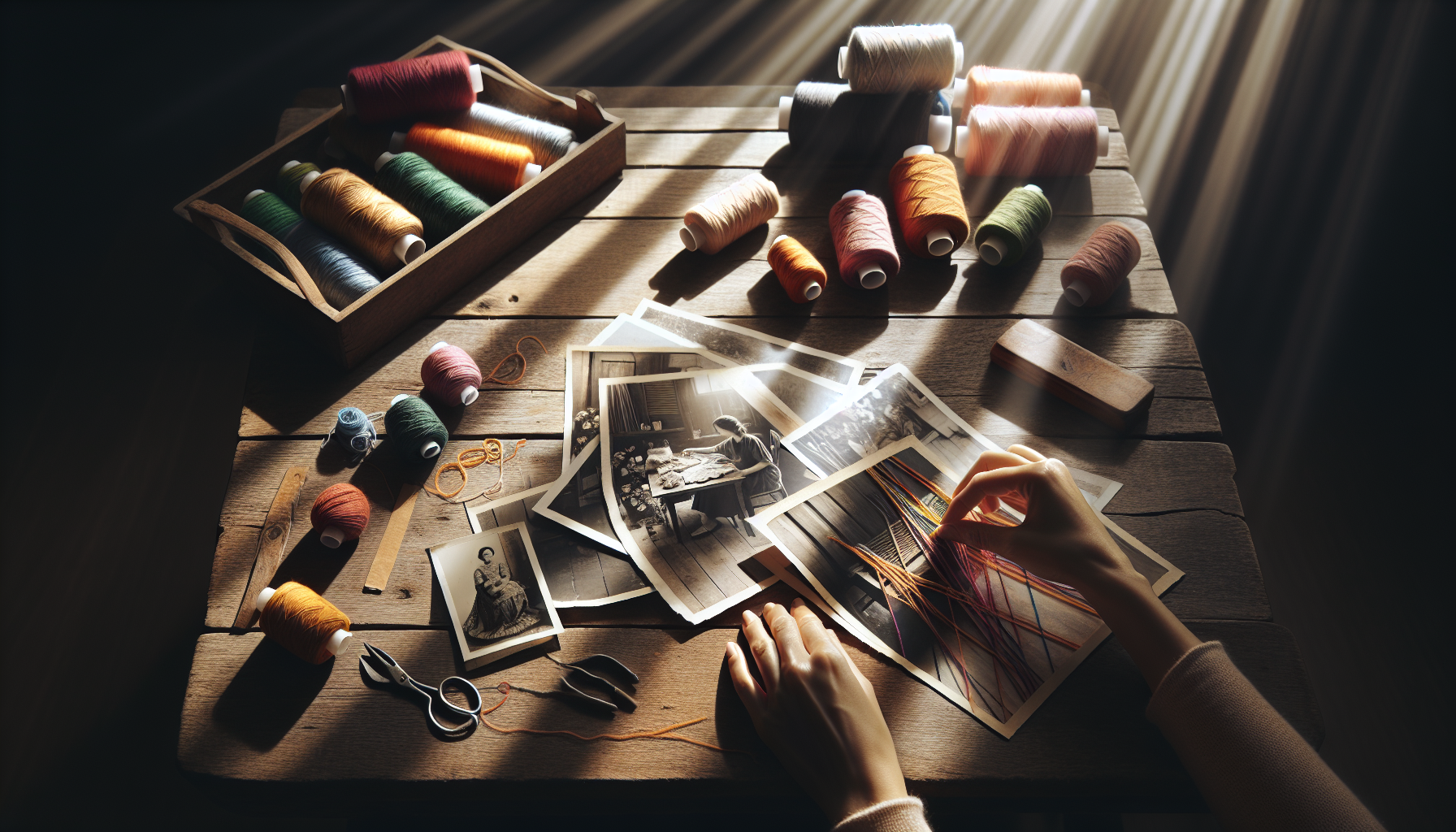
Memory weaving — the practice of incorporating photographic imagery into woven textile structures — sits at an unusual intersection of craft, technology, and personal archive. The phrase is used loosely across several related practices, but in its most technically developed form it refers to work in which the warp or weft structure of a woven cloth literally encodes photographic information: tonal values translated into thread density, portrait photographs made readable only through the textile grid.
Lia Cook is the practitioner most associated with this approach at the highest level of technical and critical ambition. Cook, a professor emerita at the California College of the Arts in Oakland, has been working since the 1970s at the intersection of weaving and digital image technology. Her large-format woven portraits — some measuring four feet square or larger — are produced on a Jacquard loom programmed with digitized photographic data, then worked over with additional hand-processes that complicate the mechanical regularity of the woven image. The result is a surface that rewards close examination: what reads from across a room as a photographic portrait resolves up close into individual threads, the weave structure visible, the photographically recorded face becoming a textile object.
Cook's work has been exhibited at the Museum of Arts and Design in New York, the Renwick Gallery of the Smithsonian in Washington, D.C., and the Textile Museum in Washington. A 2011 exhibition at the AACC Gallery explored her ongoing collaboration with neuroscientists at UC Berkeley investigating how tactile information from woven surfaces activates brain regions associated with emotional memory — a project that makes the metaphor of memory weaving literal at the neurological level. Her work is represented in the permanent collections of the American Craft Council and the Oakland Museum of California.
Karina Kalvaitis works in a different tradition, drawing on Baltic textile heritage — specifically the woven sashes and belts of Lithuanian folk practice — and reinterpreting them through contemporary photographic and archival materials. Born in Lithuania and based in the United States, Kalvaitis has used her own family's photographs and documents as source material for woven works that address displacement, diaspora, and the fragility of material memory. Her technique involves hand-spinning fibers dyed with natural pigments alongside commercially produced threads, creating surfaces in which the handmade and the industrially produced exist in deliberate tension. Her work has been shown at the Vesterheim Norwegian-American Museum in Decorah, Iowa, and at fiber arts venues including the Convergence biennial conference of the Handweavers Guild of America.
The Victoria and Albert Museum in London holds one of the world's most significant textile collections, spanning over five thousand years of production across dozens of cultures. The museum's conservation and research programs have contributed substantially to understanding how woven structures age, how dyes fade and change, and how photographic reproduction of textiles — notoriously difficult to document accurately — can be improved. The V&A's online collection database (collections.vam.ac.uk) includes over 140,000 textile records with zoomable high-resolution imagery, an invaluable resource for researchers studying historical approaches to image-making in fiber.
The pedagogical infrastructure supporting advanced textile practice in North America centers on two residential craft schools that have become international institutions. The Penland School of Craft in Penland, North Carolina, founded in 1929, offers two-week and eight-week sessions in weaving, dyeing, and related textile arts alongside programs in glass, metal, wood, clay, and photography. Its resident artists program, in which practitioners spend one to three years living and working at the school in exchange for teaching assistance, has produced an extraordinary number of significant craft practitioners. Alumni working in memory-related textile practices include several former students of Cook who have carried her approach into their own teaching.
The Haystack Mountain School of Crafts on Deer Isle, Maine, founded in 1950, operates on a similar residential model with intensive two-week sessions. Haystack's setting — a hillside descending toward the Atlantic, with studios cantilevered over the slope — has a distinct character that influences the work made there. The school has been particularly associated with experimental approaches that cross traditional craft media boundaries, and its weaving and fiber programs have hosted significant artists working at the intersection of textile and digital technology.
The technical developments that have made memory weaving possible at Cook's level of photographic fidelity are largely the result of improvements in Jacquard loom programming. Contemporary digital Jacquard looms, particularly those manufactured by Bonas Textile Machinery and AVL Looms, can execute binary lifting patterns with enough resolution to reproduce photographic tonal gradations in woven cloth. The limiting factor is not the loom's programming but the weaver's ability to choose thread colors and densities that translate the photographic image faithfully — a process that requires both technical knowledge and artistic judgment that no software fully automates.
The market for work in this field is primarily institutional rather than commercial: major acquisitions tend to come from museum permanent collections, public art commissions, and corporate collections rather than from private collectors. This reflects both the scale of the work — large woven pieces are difficult to display in domestic spaces — and the critical positioning of fiber arts within the broader art market, which has historically undervalued textile work relative to painting and sculpture. The situation has been shifting, as evidenced by the prominence of fiber artists including Sheila Hicks and El Anatsui at major international exhibitions, but the shift is incomplete.
Sources & Further Reading
- Cook, Lia. Artist website and exhibition history. liacook.com
- Victoria and Albert Museum. Textile collection online. collections.vam.ac.uk
- Penland School of Craft. penland.org
- Haystack Mountain School of Crafts. haystack-mtn.org
- Handweavers Guild of America. Convergence biennial. weavespindye.org
- Schoeser, Mary. World Textiles: A Concise History. Thames & Hudson, 2003.